
Diane Burton is a professor in the ILR School at Cornell University. Her primary appointment is in human resource studies, with courtesy appointments in organizational behavior and sociology. Prior to joining the Cornell faculty in 2009, Professor Burton was a faculty member at the MIT Sloan School of Management. She began her academic career at the Harvard Business School teaching leadership and organizational behavior. Professor Burton earned her Ph.D. in sociology at Stanford University and served as a lecturer and researcher in organizational behavior and human resources management at the Stanford Graduate School of Business.

Human Resources EssentialsCornell Certificate Program
Human Resources Essentials (ILRHRC09)
Tell me more!Online
$3,600
Overview and Courses
Course list
Based on the research and expertise of John Hausknecht, Ph.D., you will evaluate the possibility of working with or without a system, identify the properties and benefits of different systems, and explore different approaches to performance management. Steps to mitigate risk will be outlined, common rating and feedback errors will be examined, and support in delivering feedback will be provided.
View Course Start Dates Hide Course Start Dates
View Course Details- Sep 23, 2026
- Oct 7, 2026
- Oct 21, 2026
- Nov 4, 2026
- Nov 18, 2026
- Dec 2, 2026
- Dec 16, 2026
In this course, you will learn about perceptual and psychological processes that impact the way that individuals interact with people who are demographically dissimilar from them. You will examine psychological processes that impact personnel decision making within organizations. This understanding will help HR professionals to design better practices and will help line managers to more effectively leverage the potential among employees from diverse backgrounds.
The course will also help you understand why “Diversity” is now often referred to as “Diversity & Inclusion” by explaining what inclusion is and how it differs from diversity. Why is inclusion so important, and what are its building blocks?
The course will also help you understand why “Diversity” is now often referred to as “Diversity & Inclusion” by explaining what inclusion is and how it differs from diversity. Why is inclusion so important, and what are its building blocks?
View Course Start Dates Hide Course Start Dates
View Course Details- Sep 23, 2026
- Oct 7, 2026
- Oct 21, 2026
- Nov 4, 2026
- Nov 18, 2026
- Dec 2, 2026
- Dec 16, 2026
Coaching, as both an industry and an employee development tool, is growing in prominence and importance. Responsibility for coaching is increasingly falling to HR professionals, who can be called upon to coach employees directly, train managers to be better coaches, build coaching capability within the organization, and identify external coaching resources.
In this course, you will begin practicing skills and behaviors exhibited by effective coaches. The course situates coaching within the broader context of employee development, enabling you to analyze workplace situations and diagnose when coaching is an appropriate developmental tool. You'll gain insight into how both institutional awareness and self-awareness are needed to foster and support successful coaching efforts.
View Course Start Dates Hide Course Start Dates
View Course Details- Sep 23, 2026
- Oct 7, 2026
- Oct 21, 2026
- Nov 4, 2026
- Nov 18, 2026
- Dec 2, 2026
- Dec 16, 2026
Managers must foster a good workplace atmosphere and be able to deal effectively with behavior issues as they arise. Doing so improves productivity and employee engagement and helps an organization avoid costly legal liability.
Dean Alexander Colvin, Ph.D. of Cornell University's ILR School explains how new and aspiring managers can prevent or reduce the occurrence of behavior issues. His lessons will show you how to assess issues as they arise and provide guidance and best practices on resolving behavior problems, primarily through the proven principles of progressive discipline. Professor Colvin draws on his legal and research credentials to provide guidance in dealing with harassment and bullying, planning and carrying out dismissals when required, and managing requests to accommodate special employee needs and practices.
Throughout the course, you'll remain engaged as you participate in interactive discussions and complete a five-part course project, applying the key concepts to your own situation.
View Course Start Dates Hide Course Start Dates
View Course Details- Sep 23, 2026
- Oct 7, 2026
- Oct 21, 2026
- Nov 4, 2026
- Nov 18, 2026
- Dec 2, 2026
- Dec 16, 2026
How It Works
Format
All Online
Time Commitment
3 months with 3 to 8 hours of study per week
Cost
$3,600
Learn From Top Minds
Courses are developed by Cornell faculty.
Power Your Career
Gain today’s most in-demand skills to stand apart.
Flexibility Fits Your Life
Learn on your schedule without stepping out of your job.
Small-class Experience
Participate in facilitated discussions and live sessions with industry peers.
Real-world Projects
Apply learnings and insights to your work to make an impact right away.
Personalized Feedback
Enjoy meaningful feedback on assignments from expert facilitators.
Format
All Online
Time Commitment
3 months with 3 to 8 hours of study per week
Cost
$3,600
Learn From Top Minds
Courses are developed by Cornell faculty.
Power Your Career
Gain today’s most in-demand skills to stand apart.
Flexibility Fits Your Life
Learn on your schedule without stepping out of your job.
Small-class Experience
Participate in facilitated discussions and live sessions with industry peers.
Real-world Projects
Apply learnings and insights to your work to make an impact right away.
Personalized Feedback
Enjoy meaningful feedback on assignments from expert facilitators.
- View slide #1
- View slide #2
- View slide #3
- View slide #4
- View slide #5
- View slide #6
- View slide #7
- View slide #8
- View slide #9
Faculty Authors
Professor, ILR School, Cornell University
- Executive Compensation Fundamentals
- Military to Business in Project Management
- Military to Business in Marketing
- Board of Directors Forum at Cornell Tech
- Organizational Design
- Recruiting and Talent Acquisition
- Diversity, Equity, and Inclusion for HR
- Compensation and Benefits
- Human Resources Essentials
- Leadership Essentials
- Human Resources Management
Alexander Colvin
Kenneth F. Kahn '69 Dean
Cornell ILR School
Kenneth F. Kahn '69 Dean, Cornell ILR School
Alexander Colvin, Ph.D., ’99, is the Kenneth F. Kahn ’69 Dean and the Martin F. Scheinman ’75, M.S. ’76, Professor of Conflict Resolution at Cornell University’s ILR School.
Dean Colvin’s research and teaching focuses on employment dispute resolution, with a particular emphasis on procedures in non-union workplaces and the impact of the legal environment on organizations. His current research projects include empirical investigations of employment arbitration and cross-national analysis of labor law and dispute resolution. Dean Colvin is the co-author of “An Introduction to U.S. Collective Bargaining and Labor Relations” (with T. Kochan and H. Katz) and of “Arbitration Law “( with K. Stone and R. Bales).
Dean Colvin received his J.D. in 1992 from the University of Toronto and his Ph.D. in 1999 from Cornell University. He received the 2003 Outstanding Young Scholar Award from the Industrial Relations Research Association (IRRA) and the 2000 Best Dissertation Award from the IRRA for his dissertation entitled “Citizens and Citadels: Dispute Resolution and the Governance of Employment Relations.” Before joining the faculty of the ILR School, Dean Colvin taught at Penn State University from 1999 to 2008.
Professor of Human Resource Studies, Cornell University
John Hausknecht is a Professor of Human Resource Studies at Cornell University. He earned his Ph.D. in 2003 from Penn State University with a major in industrial/organizational psychology and minor in management. He received the 2004 S. Rains Wallace Award for the best dissertation in the field of industrial/organizational psychology. Professor Hausknecht’s research primarily falls within the domain of staffing and has appeared in the Academy of Management Journal, Journal of Applied Psychology, and Personnel Psychology. Recent papers have examined applicant persistence in selection settings, reactions to company hiring practices, and predictors and consequences of collective-level absenteeism and turnover. He currently serves on the editorial boards of the Academy of Management Journal, Journal of Applied Psychology, and Personnel Psychology.
Professor Hausknecht teaches undergraduate and graduate-level courses on human resource management, staffing organizations, and HR analytics. He received the ILR School’s MacIntyre Award for exemplary teaching in 2008. Prior to academia, he worked as a consultant to Fortune 500 firms in the areas of leadership assessment, talent management, and organizational change. Professor Hausknecht is a member of the Academy of Management, American Psychological Association, Society for Industrial and Organizational Psychology, and Society for Human Resource Management.
Professor and Vice Provost for Undergraduate Education, Cornell University
Lisa Nishii joined the faculty of the Human Resource Studies department at the ILR School, Cornell University after receiving her Ph.D. and M.A. in Organizational Psychology from the University of Maryland, and a B.A in economics from Wellesley College.
Nishii is an expert on inclusion in organizations. Her research focuses on the confluence of organizational practices, leadership behaviors, and climate for inclusion on individual- and group-level outcomes. Using multi-level and multi-method research designs across a number of large-scale federally funded projects, she has found that leaders play an important role in shaping inclusion. In particular, the extent to which leaders role model inclusive behaviors, clarify the learning and innovation benefits of diversity for the group’s work, and set strong norms related to interpersonal interactions, determines the inclusiveness of their workgroup climates. In turn, workgroup climate has important implications for the authenticity of the relationship that group members develop, the positive versus negative quality of relational ties, the information that is shared among group members, the extent of conflict that is experienced, and ultimately the creativity, financial performance, and turnover rates associated with these groups. Workgroup climate also impacts individual-level experiences of discrimination versus inclusion, as well as engagement and performance. She is currently developing and testing the effectiveness of training interventions for leaders as well as for in-tact teams on how to cultivate workgroup inclusion. Nishii’s earlier research focused primarily on diversity in individual-level cognition and behavior as determined by national culture.
Nishii actively publishes in top-tier journals, including the Academy of Management Review, Academy of Management Journal, Journal of Applied Psychology, Personnel Psychology, and Science, and serves on the editorial boards for AMR, AMJ, and JAP. She is currently the Chair of the Academy of Management’s Gender and Diversity in Organizations Division, and the Chair of the ILR School’s International Programs. She serves on a variety of college and university-level councils for diversity, globalization, and engaged learning. Nishii also consults with multinational companies, primarily related to diversity and inclusion and organizational assessment.
Judi Brownell
Professor Emeritus
Cornell Nolan School of Hotel Administration
Professor Emeritus, Cornell Nolan School of Hotel Administration
Judi Brownell is Professor Emeritus at the Nolan School of Hotel Administration, Cornell University, where she has served as Dean of Students, Associate Dean of Academic Affairs, and Director of Graduate Studies. Dr. Brownell teaches graduate and undergraduate courses in listening, leadership, communication, and organizational behavior, and her online programs are taken worldwide. Her current research interests include identifying key competencies associated with leadership effectiveness, managerial listening behavior, and enhancing service quality.
Dr. Brownell has published nearly 100 articles in professional journals and written numerous other publications. Her textbooks include “The Listening Advantage”; “Organizational Behavior for the Hospitality Industry” (with Florence Berger); “Organizational Communication and Behavior” (with Allan Frank); and “Listening: Attitudes, Principles, and Skills,” now in its seventh edition. A past president of the International Listening Association and the recipient of listening research awards, Dr. Brownell has been inducted into the International Listening Association’s Hall of Fame.
JR Keller
Associate Professor of Human Resource Studies
Cornell ILR School
Associate Professor of Human Resource Studies, Cornell ILR School
JR Keller is an Associate Professor of Human Resource Studies in the ILR School at Cornell University. Professor Keller’s research focuses on understanding how firms make hiring decisions and individuals make career choices, with a particular interest in the ways in which the dynamics shape how employees change jobs within firms.
Professor Keller’s work has appeared in several leading academic and practitioner outlets, including Administrative Science Quarterly, Academy of Management Journal, Academy of Management Review, Harvard Business Review, Industrial & Labor Relations Review, People & Strategy, and Organization Science.
Prior to pursuing a Ph.D., Professor Keller had two careers: the first as a financial analyst and the second as a career consultant. He earned his Ph.D. in Management from the Wharton School of Business and holds a Master’s in Adult Education from Indiana University as well as undergraduate degrees in Finance and Computer Applications from the University of Notre Dame.

Diane Burton
Professor
Cornell ILR School
Professor, ILR School, Cornell University
Diane Burton is a professor in the ILR School at Cornell University. Her primary appointment is in human resource studies, with courtesy appointments in organizational behavior and sociology. Prior to joining the Cornell faculty in 2009, Professor Burton was a faculty member at the MIT Sloan School of Management. She began her academic career at the Harvard Business School teaching leadership and organizational behavior. Professor Burton earned her Ph.D. in sociology at Stanford University and served as a lecturer and researcher in organizational behavior and human resources management at the Stanford Graduate School of Business.
- Executive Compensation Fundamentals
- Military to Business in Project Management
- Military to Business in Marketing
- Board of Directors Forum at Cornell Tech
- Organizational Design
- Recruiting and Talent Acquisition
- Diversity, Equity, and Inclusion for HR
- Compensation and Benefits
- Human Resources Essentials
- Leadership Essentials
- Human Resources Management

Alexander Colvin
Kenneth F. Kahn '69 Dean
Cornell ILR School
Kenneth F. Kahn '69 Dean, Cornell ILR School
Alexander Colvin, Ph.D., ’99, is the Kenneth F. Kahn ’69 Dean and the Martin F. Scheinman ’75, M.S. ’76, Professor of Conflict Resolution at Cornell University’s ILR School.
Dean Colvin’s research and teaching focuses on employment dispute resolution, with a particular emphasis on procedures in non-union workplaces and the impact of the legal environment on organizations. His current research projects include empirical investigations of employment arbitration and cross-national analysis of labor law and dispute resolution. Dean Colvin is the co-author of “An Introduction to U.S. Collective Bargaining and Labor Relations” (with T. Kochan and H. Katz) and of “Arbitration Law “( with K. Stone and R. Bales).
Dean Colvin received his J.D. in 1992 from the University of Toronto and his Ph.D. in 1999 from Cornell University. He received the 2003 Outstanding Young Scholar Award from the Industrial Relations Research Association (IRRA) and the 2000 Best Dissertation Award from the IRRA for his dissertation entitled “Citizens and Citadels: Dispute Resolution and the Governance of Employment Relations.” Before joining the faculty of the ILR School, Dean Colvin taught at Penn State University from 1999 to 2008.

John Hausknecht
Professor
Cornell ILR School
Professor of Human Resource Studies, Cornell University
John Hausknecht is a Professor of Human Resource Studies at Cornell University. He earned his Ph.D. in 2003 from Penn State University with a major in industrial/organizational psychology and minor in management. He received the 2004 S. Rains Wallace Award for the best dissertation in the field of industrial/organizational psychology. Professor Hausknecht’s research primarily falls within the domain of staffing and has appeared in the Academy of Management Journal, Journal of Applied Psychology, and Personnel Psychology. Recent papers have examined applicant persistence in selection settings, reactions to company hiring practices, and predictors and consequences of collective-level absenteeism and turnover. He currently serves on the editorial boards of the Academy of Management Journal, Journal of Applied Psychology, and Personnel Psychology.
Professor Hausknecht teaches undergraduate and graduate-level courses on human resource management, staffing organizations, and HR analytics. He received the ILR School’s MacIntyre Award for exemplary teaching in 2008. Prior to academia, he worked as a consultant to Fortune 500 firms in the areas of leadership assessment, talent management, and organizational change. Professor Hausknecht is a member of the Academy of Management, American Psychological Association, Society for Industrial and Organizational Psychology, and Society for Human Resource Management.

Lisa Nishii
Professor and Vice Provost
Cornell ILR School
Professor and Vice Provost for Undergraduate Education, Cornell University
Lisa Nishii joined the faculty of the Human Resource Studies department at the ILR School, Cornell University after receiving her Ph.D. and M.A. in Organizational Psychology from the University of Maryland, and a B.A in economics from Wellesley College.
Nishii is an expert on inclusion in organizations. Her research focuses on the confluence of organizational practices, leadership behaviors, and climate for inclusion on individual- and group-level outcomes. Using multi-level and multi-method research designs across a number of large-scale federally funded projects, she has found that leaders play an important role in shaping inclusion. In particular, the extent to which leaders role model inclusive behaviors, clarify the learning and innovation benefits of diversity for the group’s work, and set strong norms related to interpersonal interactions, determines the inclusiveness of their workgroup climates. In turn, workgroup climate has important implications for the authenticity of the relationship that group members develop, the positive versus negative quality of relational ties, the information that is shared among group members, the extent of conflict that is experienced, and ultimately the creativity, financial performance, and turnover rates associated with these groups. Workgroup climate also impacts individual-level experiences of discrimination versus inclusion, as well as engagement and performance. She is currently developing and testing the effectiveness of training interventions for leaders as well as for in-tact teams on how to cultivate workgroup inclusion. Nishii’s earlier research focused primarily on diversity in individual-level cognition and behavior as determined by national culture.
Nishii actively publishes in top-tier journals, including the Academy of Management Review, Academy of Management Journal, Journal of Applied Psychology, Personnel Psychology, and Science, and serves on the editorial boards for AMR, AMJ, and JAP. She is currently the Chair of the Academy of Management’s Gender and Diversity in Organizations Division, and the Chair of the ILR School’s International Programs. She serves on a variety of college and university-level councils for diversity, globalization, and engaged learning. Nishii also consults with multinational companies, primarily related to diversity and inclusion and organizational assessment.

Judi Brownell
Professor Emeritus
Cornell Nolan School of Hotel Administration
Professor Emeritus, Cornell Nolan School of Hotel Administration
Judi Brownell is Professor Emeritus at the Nolan School of Hotel Administration, Cornell University, where she has served as Dean of Students, Associate Dean of Academic Affairs, and Director of Graduate Studies. Dr. Brownell teaches graduate and undergraduate courses in listening, leadership, communication, and organizational behavior, and her online programs are taken worldwide. Her current research interests include identifying key competencies associated with leadership effectiveness, managerial listening behavior, and enhancing service quality.
Dr. Brownell has published nearly 100 articles in professional journals and written numerous other publications. Her textbooks include “The Listening Advantage”; “Organizational Behavior for the Hospitality Industry” (with Florence Berger); “Organizational Communication and Behavior” (with Allan Frank); and “Listening: Attitudes, Principles, and Skills,” now in its seventh edition. A past president of the International Listening Association and the recipient of listening research awards, Dr. Brownell has been inducted into the International Listening Association’s Hall of Fame.

JR Keller
Associate Professor of Human Resource Studies
Cornell ILR School
Associate Professor of Human Resource Studies, Cornell ILR School
JR Keller is an Associate Professor of Human Resource Studies in the ILR School at Cornell University. Professor Keller’s research focuses on understanding how firms make hiring decisions and individuals make career choices, with a particular interest in the ways in which the dynamics shape how employees change jobs within firms.
Professor Keller’s work has appeared in several leading academic and practitioner outlets, including Administrative Science Quarterly, Academy of Management Journal, Academy of Management Review, Harvard Business Review, Industrial & Labor Relations Review, People & Strategy, and Organization Science.
Prior to pursuing a Ph.D., Professor Keller had two careers: the first as a financial analyst and the second as a career consultant. He earned his Ph.D. in Management from the Wharton School of Business and holds a Master’s in Adult Education from Indiana University as well as undergraduate degrees in Finance and Computer Applications from the University of Notre Dame.
- View slide #1
- View slide #2
- View slide #3
- View slide #4
- View slide #5
- View slide #6
Key Course Takeaways
- Train managers to deliver effective performance feedback, rate employees accurately, and mitigate legal risk
- Critically assess whether the organizational and HR practices in place are likely to exacerbate or reduce the negative outcomes associated with unconscious bias
- Familiarize yourself with the employee development landscape at your organization
- Diagnose the root causes of a situation and determine who in the organization will be the primary focus of an intervention
- Assemble the different dimensions of interpersonal communication and apply them to difficult conversations
- Determine current workforce needs with an eye to future changes and skills that might be needed
- Develop a hiring plan that maximizes your likelihood of a good hire and communicate effectively with job candidates
- Create a workplace atmosphere that reduces the occurrence of behavior issues and resolve issues as they arise

Download Brochure
Fill out the form below to download program information and connect
with us.
Download a Brochure
Not ready to enroll but want to learn more? Download the certificate brochure to review program details.“
I decided to invest in my future and work toward a career in HR. As a dad of two with a full time job, this online program gave me the chance to work when I could. It was a fantastic way for me to develop my skills and advance my career.
‐ John F.
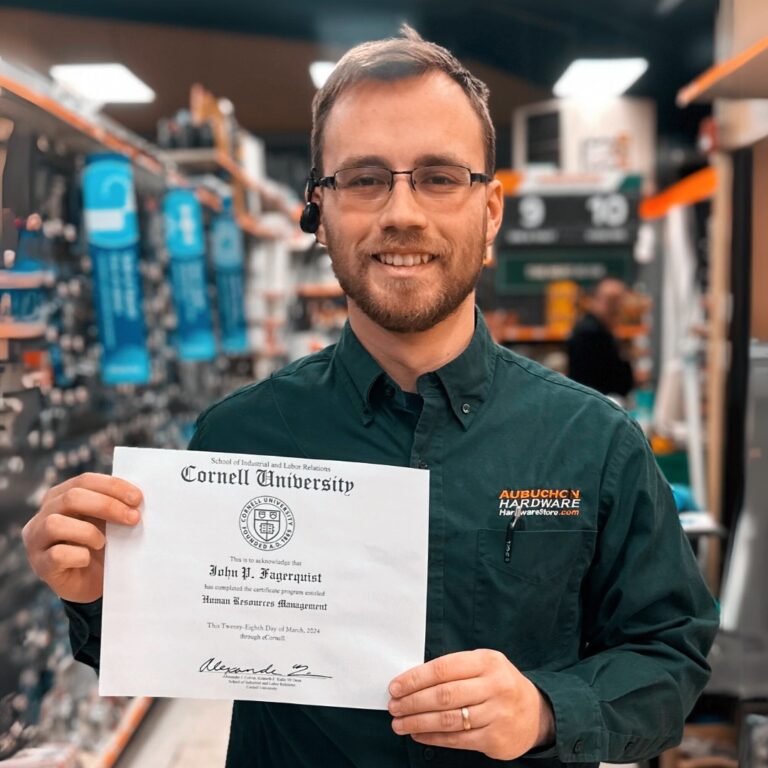
What You'll Earn
Human Resources Essentials Certificate from Cornell ILR School
48 Professional Development Hours (4.8 CEUs)
15 Professional Development Units (PDUs) toward PMI recertification
42 Professional Development Credits (PDCs) toward SHRM-CP and SHRM-SCP recertification
Watch the Video
Hear a Human Resources student share his story.
Who Should Enroll
- Global professionals from for-profits, NGOs, and governmental agencies
- Line-level HR professionals
- Anyone who performs HR functions
- Aspiring HR professionals
Request Information Now by completing the form below.
Act today—courses are filling fast.
Purchase Options
3600

Human Resources Essentials
| Select Payment Method | Cost |
|---|---|
| $3,600 | |
Review Program Pricing and Details